Thinking Like A Venture Capitalist #3
How the platform I kept breaking my own code on taught me that in B2B, the person who loves the product is almost never the person who pays for it.
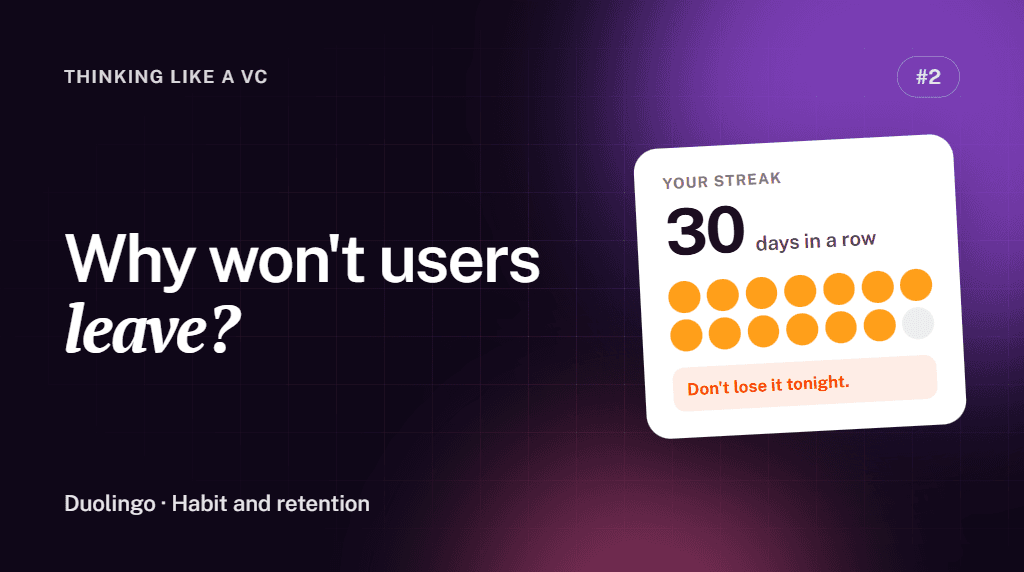
Alright, we are back again. Last time I looked at Duolingo and walked away convinced that the most important question you can ask about any consumer business is why will users not leave. The streak, the hearts, the owl that guilt-trips you at 11 p.m. Every piece of that app is engineered around keeping you from walking away. I ended that article saying I wanted to move into the B2B software world next, because every company I had looked at so far sold directly to individual people, and I had a feeling the rules would look different when the customer is another business.
I was right that the rules look different. I was wrong about how. I went into this one thinking I would just take my Duolingo question and apply it to a company that sells software to businesses. Why will users not leave? It turns out that in B2B that question has a hidden problem baked into it, which is that the user and the customer are usually not the same person. I did not even realize that was a distinction until I was halfway through my research.
The company I picked this time is Vercel. If you read the first article in this series, you might remember me talking about how many failed production deployments I stared at while trying to get the Regret Calculator live. Those deployments were on Vercel. I have spent more late nights on that dashboard than I would like to admit, watching build logs scroll by and refreshing a page to see if a single red error turned green. So once again, I picked a company I thought I understood because I use it all the time.
The Company I Thought Was Just a Button
Before I did any research, I thought of Vercel as a really nice button. You connect your GitHub repo, you click deploy, and your website shows up on the internet. I assumed the business was basically web hosting with a better design, the kind of thing where you pay a few dollars a month to keep a site online. I also assumed that because I had never paid them a single dollar, they were probably not making much money from people like me. I figured the free tier was a charity for students.
Then I looked it up. Vercel raised a Series E in 2024 at a valuation of about 3.25 billion dollars. A company I thought of as a deploy button was worth billions, and a huge part of the story has nothing to do with hosting at all. It has to do with a piece of free, open-source software that I had been using the entire time without ever thinking about who made it.
The Free Framework is the Front Door
Vercel is the company behind Next.js. If you do not build websites, Next.js is a framework, which is basically a set of rules and tools that make building a modern website much faster. It is free. It is open source. Anybody can download it, use it and host it wherever they want. The website you are reading this on is built with it. When I first learned that Vercel gives away the thing that took them years to build, it made zero sense to me. Why would you give away your best work?
The answer is the same idea I found at Duolingo, just pointed at a completely different kind of user. Duolingo gives away language lessons so that hundreds of millions of people get attached before they ever see a paywall. Vercel gives away the framework so that millions of developers learn to build a certain way before they ever see a bill. When a developer who learned on Next.js needs a place to put their project, the most natural place is the company that made the tool. The framework is the free product. The hosting is where the money is. It is the same move, just dressed up for engineers instead of language learners.
The Person Who Loves It is Not the Person Who Pays
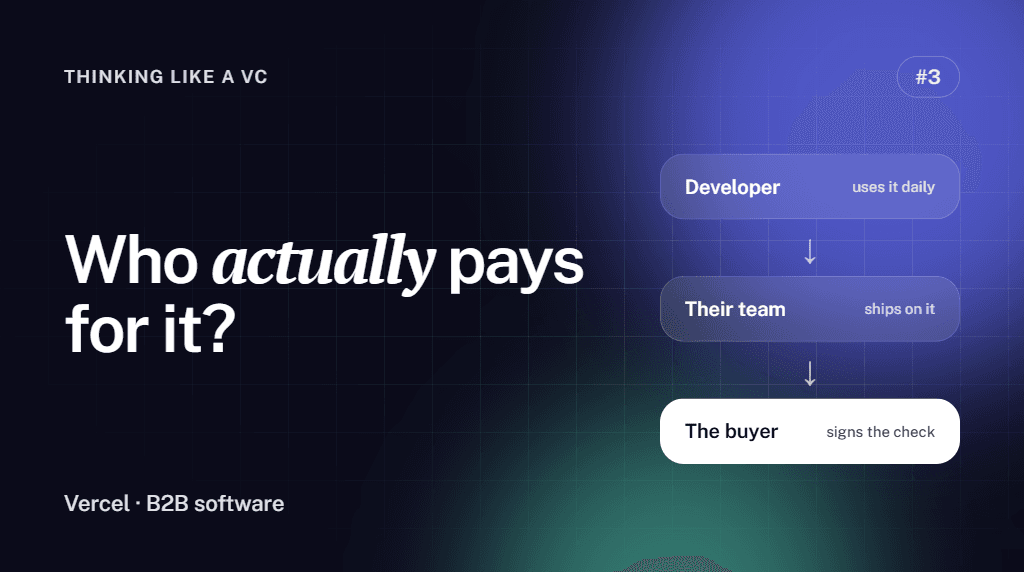
This is the part that broke my Duolingo framework. On Duolingo, the person who opens the app every day is the same person who decides whether to pay for Super Duolingo. The user and the customer are one person. In B2B, that is almost never true. At a company, the developer is the one who uses Vercel every day. But the person who signs the contract is usually a manager, a head of engineering, or someone in finance who has never pushed a line of code in their life.
So Vercel has to win two completely different people. It wins the developer by being free, fast and genuinely fun to use. Then that developer brings it into their job. Maybe they deploy a side project, then a small internal tool, then something the whole team depends on. By the time a finance person is looking at an invoice, the product is already woven into how the team works. People call this product-led growth, and I had heard the phrase a hundred times without actually understanding it. It just means the product does the selling that a sales team would normally have to do. The developer is the salesperson, and they are not even on the payroll.
The paid plans make this really obvious once you look at them. The Pro plan is priced per team member, around 20 dollars a month for each person. That means Vercel does not just grow when a company launches more websites. It grows when the company hires more engineers. Every new person on the team is more revenue. That is a very different engine from a single person paying to protect a streak.
Why Businesses Do Not Leave
So I went back to my favorite question from last time, why will users not leave, and tried to answer it for Vercel. The answer was not psychology. Nobody at a company feels emotionally attached to a deployment dashboard the way I felt attached to a 30-day Duolingo streak. The answer was workflow. Once a team has its previews, its domains, its environment variables and its entire release process set up in one place, leaving means rebuilding all of that while the product is still running. Nobody wants to be the engineer who breaks production to save a few hundred dollars a month.
That is what people mean by switching costs, and it is a much sturdier kind of lock-in than a streak. A streak can reset and you can shrug it off. A company rebuilding its entire deployment pipeline is a project with meetings, deadlines and risk. Duolingo makes you feel like you should not leave. Vercel makes it genuinely expensive to leave. That was the biggest difference between consumer and B2B that I found, and I would not have seen it without having the Duolingo article to compare against.
The Question I Forgot to Ask
Here is where I have to be honest with myself. Halfway through writing this, I started reading about the other side of Vercel, and I realized I had spent two whole articles asking why users stay without ever asking what it costs to serve them. Vercel does not own the giant data centers that the internet runs on. A big part of what it does is sit on top of infrastructure from cloud providers and make it much easier to use. That means every time a site gets a spike of traffic, somebody pays for the servers, and it is not always obvious how much of that cost Vercel keeps versus passes along.
This is also why you can find developers online complaining about surprise bills when a project suddenly goes viral. From the investor side, that is a real question. A company can have users who love it and never leave and still have a hard time making money if every new user costs almost as much to serve as they pay. I had been treating retention like it was the whole story. It is only half of it. The other half is margin, and I skipped it completely in both of my last two articles.
Moving Forward
Looking at CookUnity, Duolingo and now Vercel side by side, I am starting to see a pattern. All three give something away or remove a barrier so that people show up and build on top of them. CookUnity removes the cost of opening a restaurant. Duolingo removes the price of learning a language. Vercel removes the cost of learning a modern way to build. But this time I learned that the question of why people stay is not enough on its own. You also have to ask who actually pays, and what it costs you every time they use the product.
September is basically here. The next time I write, I will be writing from Manhattan, which is honestly still hard for me to believe. For the next one, I want to fix the mistake I just caught myself making. I want to pick a company where everyone knows the product and almost nobody thinks about what each order actually costs, and follow the money all the way down to a single transaction.
Keep building, but figure out who is actually paying for it.